
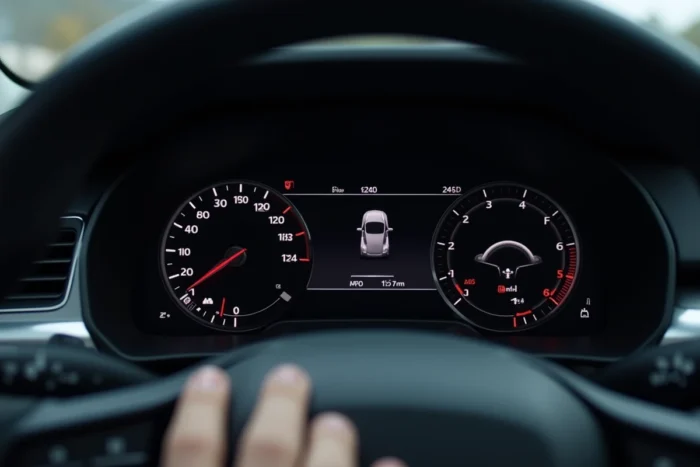
After a battery change, the dashboard of a recent vehicle may display confusing behavior: warning lights illuminated in sequence, comfort functions disabled, or unstable idling. These manifestations do not indicate a fault with the new battery, but rather a temporary loss of the parameters stored by the control units. Knowing which points to check on the dashboard after a battery change helps distinguish normal behavior from a real problem requiring intervention.
Battery warning light on with engine running: a charging fault, not a battery issue
The red battery-shaped warning light on the instrument cluster is probably the most misunderstood. It does not indicate that the battery is faulty. It signals a charging system anomaly: alternator, wiring, or voltage regulator.
Under normal operation, this light comes on when the ignition is turned on, then goes off immediately after the engine starts. If it remains on while the engine is running after installing a new battery, the battery itself is generally not the cause.
The priority is then to check the voltage at the battery terminals while the engine is running. A value between 13.5 and 14.5 V confirms that the alternator is functioning properly. If it is below this range, the electrical harness or alternator warrants diagnosis. Before heading to the workshop, it is useful to check the dashboard after battery replacement to precisely identify the warning lights involved and their behavior while driving.

Multiple warning lights after battery replacement: a criticality table
The simultaneous appearance of several warning lights (engine, battery, power steering, STOP) after a battery change often raises concerns, but their meaning varies depending on the combination. Here is a summary table to guide the diagnosis.
| Displayed warning light(s) | Probable cause | Action to take |
|---|---|---|
| Battery only, engine running | Charging circuit fault (alternator, wiring) | Measure voltage with engine running |
| Engine (check engine) only | Loss of sensor adaptation after power interruption | Perform a driving cycle; the light often goes off after a few kilometers |
| Battery + STOP | Insufficient charge, imminent stalling risk | Turn off non-essential consumers, head to a workshop |
| ABS + ESP + power steering | Incomplete reset of control units | Reset procedure via diagnostic tool (OBD scanner) |
| No warning light, dashboard off | Poor terminal connection or blown fuse | Check the tightness of the terminals and the condition of the main fuse |
The simultaneous presence of the battery warning light and the STOP light constitutes the most critical scenario. It means that the voltage in the onboard network has dropped below a safe operating threshold. Driving under these conditions exposes you to a loss of power steering or braking assistance.
Resetting engine parameters and comfort functions
The power interruption caused by removing the old battery erases the learned values stored in several control units. The engine may then exhibit unstable idling during the first few kilometers, while the injection control unit relearns the idle, mixture, and throttle position parameters.
This phenomenon is normal and usually corrects itself after a driving cycle of about ten minutes, provided the engine is not turned off during this phase. However, if the idling remains erratic beyond this point, a reset via an OBD diagnostic tool becomes necessary.
The comfort functions undergo the same erasure. Here are the elements to systematically recalibrate:
- Power windows often lose their end-of-travel position. The relearning procedure involves holding the switch in the up position for a few seconds after full closure, then in the down position after full opening.
- The sunroof, when equipped, requires the same recalibration procedure for its mechanical stops.
- The clock, radio, and station presets are reset. Some car radios require a anti-theft security code to reactivate: this code is found in the maintenance booklet or on a card provided at the time of vehicle purchase.
Start-stop vehicles: registering the battery in the control unit
On vehicles equipped with a start-stop system, replacing the battery is not limited to a physical exchange. The Battery Energy Management (BEM) system continuously monitors the state of charge and adapts the engine cut-off and restart strategy based on the characteristics of the installed battery.
Without registering the new battery in the control unit, the BEM continues to operate with the parameters of the old battery. The consequences are tangible: the start-stop may no longer activate, energy recovery functions during braking are limited, and the new battery risks premature degradation due to overcharging or chronic undercharging.
Registration requires a compatible diagnostic tool (OBD scanner or specialized software). The procedure involves entering the capacity, technology (AGM or EFB), and sometimes the reference number of the new battery. On some models, the current sensor located on the negative terminal must also be recalibrated.
Checking terminals and tightness: a poor connection mimics an electronic fault
Before considering a software diagnosis, a physical check of the connections is essential. An insufficient tightening of the terminals on the posts causes micro-interruptions in voltage that produce exactly the same symptoms as an electronic fault: errant warning lights, intermittent display cuts, loss of memory in the control units.
The positive terminal must be connected first during installation, and the negative terminal last. The reverse order exposes you to the risk of a short circuit if a tool comes into contact with the bodywork. After tightening, a slight manual attempt to rotate the terminal should produce no play.
A visual inspection can also reveal any oxidation on the terminals, recognizable by a whitish or greenish deposit. This deposit increases electrical resistance and may be enough to drop the voltage perceived by the control units below the alert threshold, triggering warning lights unrelated to the battery.
The dashboard of a modern vehicle reflects the state of dozens of interconnected control units. After a battery change, most displayed alerts disappear on their own after a driving cycle and the manual recalibrations of the openings. Only the persistent battery warning light with the engine running and the battery-STOP combination justify a quick stop and a charging diagnosis.