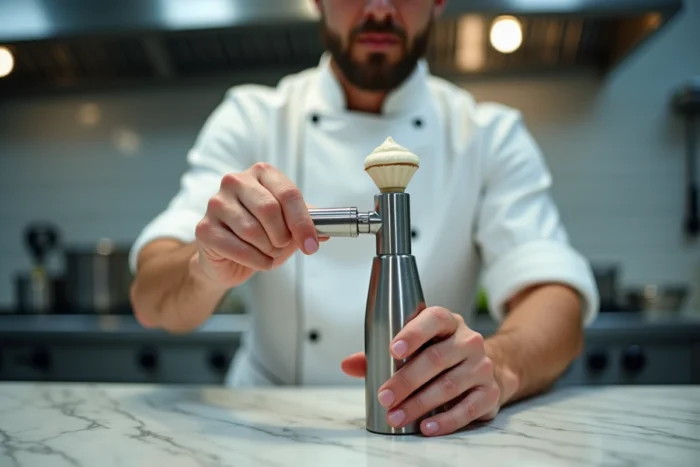
A whipped cream siphon that expels air while still containing cream is a problem most users have encountered at least once. This phenomenon is not random. It results from an imbalance between gas pressure, the viscosity of the mixture, and the internal geometry of the container. Understanding these mechanisms helps reduce waste and make the most of each filling.
Whipped Cream Siphon: The Pitfall of Overfilling
Most guides focus on the pressure or temperature of the cream. A factor often overlooked acts upstream: the volume of mixture poured into the tank. Filling the siphon beyond two-thirds of its capacity compresses the space reserved for gas. Nitrous oxide (N2O), once injected by the cartridge, needs sufficient free volume to dissolve in the fat and exert uniform pressure on the entire liquid.
When the tank is too full, the gas saturates the upper part without properly reaching the cream at the bottom. At the moment of serving, the first doses come out normally, then the pressure drops sharply. There remains a mass of liquid cream, insufficiently charged with gas, that the release cannot expel.
A similar mechanism is found with savory or sweet foams: professional chefs working with a siphon apply the two-thirds maximum volume rule and finely filter their mixture before charging it. These two precautions limit both solid residues that clog the valve and pockets of cream trapped out of reach of the gas.
An article detailing why there is still whipped cream in the tank confirms that the distribution of gas inside the container follows precise physical principles, and that even the slightest imbalance alters the result.
Fat Content and Temperature: Two Related Variables
The cream used plays a direct role. A cream with less than 25% fat content does not foam properly in the siphon. The N2O dissolves in the fat globules, and it is this dissolution that creates the airy texture upon exit. With a light cream, the gas passes through the liquid without attaching to it. The result: cream that comes out liquid on the first presses, then stagnates at the bottom of the tank as a watery residue.
Temperature also plays a complementary role. Insufficiently cold cream behaves differently under pressure. The fats remain too fluid to trap gas bubbles, and the resulting foam lacks stability. It quickly falls back into the siphon instead of exiting through the nozzle.
What Temperature Changes Concretely
A cream taken out of the refrigerator for more than a few minutes loses its ability to foam. Field reports vary on the exact time, but the principle remains constant: the cream must be very cold at the time of loading. Some professionals also chill the siphon itself before use to maintain the cold chain throughout the service.
Conversely, cream that is too thick (double cream, pure mascarpone) can also pose a problem. Its viscosity prevents the gas from distributing evenly. The sweet spot is with whole liquid cream, well chilled, with sufficient fat content.
Fat Residues and Siphon Maintenance: An Invisible Cause of Clogging
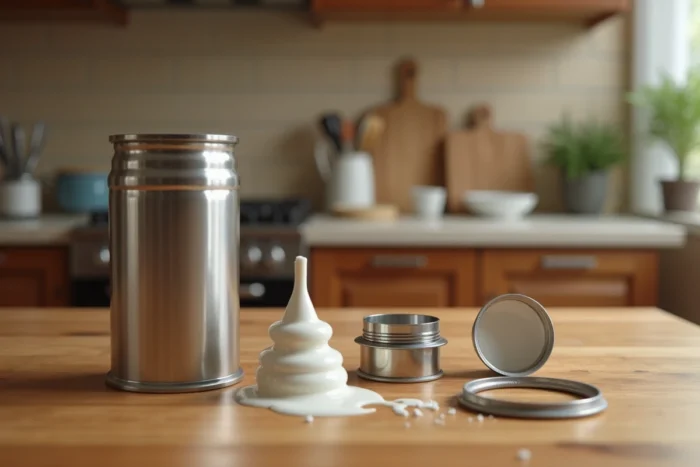
A siphon that is not properly cleaned after each use accumulates fat deposits on the internal walls, around the seal, and in the nozzle conduit. Dairy fats solidify quickly when in contact with cold, creating partial obstructions that are sometimes invisible to the naked eye.
These deposits reduce the outlet diameter. The cream, instead of flowing freely under gas pressure, encounters resistance that holds it back in the tank. The phenomenon worsens with each use if cleaning remains superficial.
Cleaning Points Not to Neglect
- The O-ring of the lid, which accumulates greasy residues and loses its seal over time, allowing pressure to leak.
- The nozzle and its internal conduit, where dried cream forms a partial blockage that hot water alone may not always dissolve.
- The cartridge holder, whose threading retains traces of grease that alter the quality of the gas cartridge piercing.
- The bottom of the tank, often rinsed quickly but rarely scrubbed, where the heaviest residues settle.
A complete disassembly after each use, with soapy hot water and a suitable brush, is enough to prevent most blockages related to dirt buildup.
Serving Gesture and Siphon Inclination: The Last Parameter
Even with suitable cream, correct filling, and a clean siphon, the position of the siphon at the time of serving determines whether the cream comes out or remains trapped. The dip tube that descends to the bottom of the tank only works properly when the siphon is held upside down, almost vertically.
Inclined at 45 degrees or less, the dip tube sucks in a mixture of air and cream. The gas escapes first, the pressure drops, and the remaining cream no longer finds the driving force to rise. This positioning flaw is probably the most frequent cause of waste, and the easiest to correct.
Summary of Actions to Adopt
- Shake the siphon upside down before each use (not just at the first serving) to re-homogenize the gas-cream mixture.
- Keep the siphon vertical, nozzle down, throughout the expulsion process.
- Activate the release with firm, brief presses rather than continuous pressure, which encourages gas escape without bringing the cream along.
A siphon properly filled to two-thirds, with cold cream of sufficient fat content, cleaned after each use, and held vertically during service, leaves very few residues. The amount of cream lost goes from a significant portion to a negligible amount. Waste is not a fatality linked to the device; it is the cumulative result of small deviations in each of these parameters.