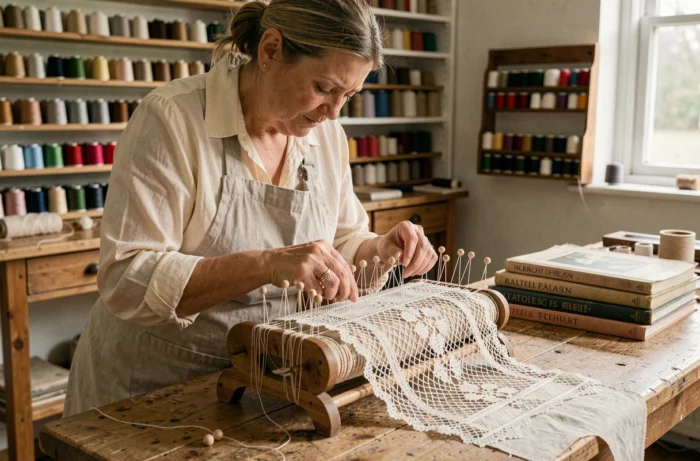
Lace and artisanal embroidery are experiencing a revival that goes beyond mere aesthetic trends. These textile techniques, long confined to a heritage imagination, are now at the intersection of very current concerns: extending the lifespan of clothing, defending threatened craftsmanship, and responding to a demand for unique pieces far from standardized production.
Bobbin lace, needle lace, crochet: distinct technical gestures
Have you ever closely observed an old doily, wondering how this network of threads could hold without fabric underneath? This is the very principle of lace: an openwork textile made without a prior woven base.
Bobbin lace relies on the crossing and twisting of threads wound onto small wooden bobbins. The artisan follows a pattern pinned with pins on a cushion. Each movement alters the tension of the thread and creates a geometric or floral pattern. It is a slow, silent work that requires precise coordination of both hands.
Needle lace works differently. A single thread and a needle are enough. The basic stitch, called the buttonhole stitch, is repeated and varied to form fillings, brides, and picots. The result is often finer and freer than bobbin lace.
Crochet, on the other hand, uses a small metal hook to pull loops of thread through other loops. It is the most accessible technique for beginners. It allows for the quick production of pieces of varying sizes, from a collar to a sofa throw.
The artisans who share their news on the Madame Dentelle website regularly testify to the diversity of these approaches and their adaptation to contemporary uses.
Artisanal embroidery and textile repair: the same gesture, two purposes
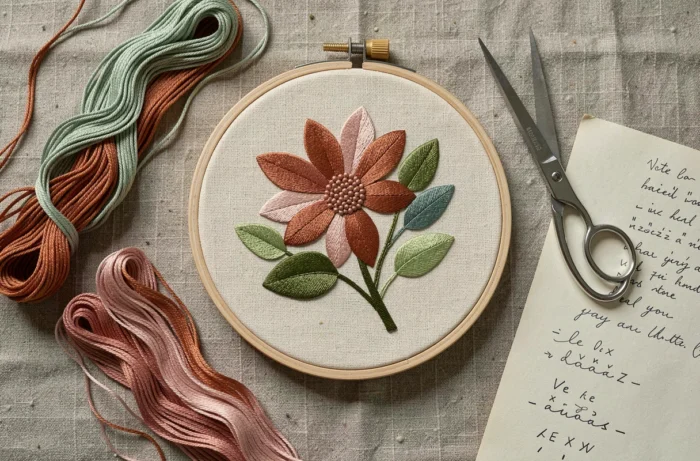
Embroidery is not just for decoration. In several introductory workshops, such as Claire Barberot’s in Strasbourg, participants learn to embroider directly on damaged clothing. A tear at the elbow of a linen jacket becomes the support for a floral motif. A permanent stain on jeans disappears under embroidered foliage.
Embroidering to repair extends the lifespan of a garment without turning it into a museum piece. The gesture remains artisanal, but the purpose is decidedly practical. It is a logical extension of the trend towards textile upcycling.
This approach is distinct from purely ornamental embroidery by its starting point: one does not begin with new fabric and a pattern chosen from a catalog, but with a defect to transform. The result is always unique, as each tear dictates the shape of the motif.
Textured embroidery and botanical motifs
On the decorative trends side, two clear directions emerge. The first is relief embroidery, which plays on the thickness of threads and the layering of stitches to create a three-dimensional effect. A rose petal embroidered in relief protrudes from the surface of the fabric by a few millimeters, radically changing the tactile perception.
The second direction is the minimalist botanical motif. A few blades of grass, a fern leaf, a sprig of thyme embroidered in one or two colors on ecru linen. The effect relies on the simplicity of the design and the quality of the stitch, not on the accumulation of colors.
Art embroidery training: from hobby to recognized diploma
The amateur practice of embroidery has seen a resurgence of interest in recent years, fueled by social media and ready-to-embroider kits. But the professional sector also exists, and it is more structured than one might often think.
The CAP Arts of Embroidery has been registered with the RNCP under number 42105 since September 2026. This diploma validates specific skills: reading technical drawings, mastering different stitches, and the ability to work on various supports. There is also a BMA Embroidery (certificate of crafts), a step up in the hierarchy of qualifications.
Specialized schools train for these professions. The art embroidery school in Locronan, Brittany, welcomes trainees in a setting directly linked to the Breton textile heritage. GRETA CDMA in Paris offers diploma courses accessible to adults in retraining.
- The CAP Arts of Embroidery validates the basic skills to work in a workshop or as a freelancer
- The BMA Embroidery deepens the know-how in art embroidery, with a focus on creation and restoration
- Short courses (from a few days to a few weeks) allow for testing the practice before committing to a diploma program
The transmission of these gestures remains a pressing issue, as many skills lack official training pathways beyond these few identified programs.
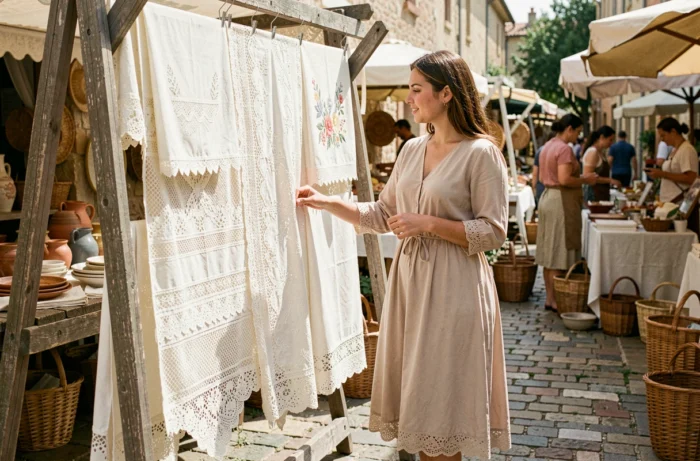
Geographical protection of French lace: what the geographical indication changes
The lace from Calais-Caudry is one of the few French textile productions to benefit from protection by geographical indication. This system, extended at the European level to artisanal and industrial products, certifies that the lace bearing this mention is indeed made in the concerned geographical area, according to defined production criteria.
Why does this protection change the game? Because it sets a verifiable framework. A geographical indication protects an origin and manufacturing criteria, allowing consumers to distinguish locally produced lace from imports.
This protection does not solve everything. It does not guarantee the economic viability of workshops, nor the renewal of skilled labor. The production cost constraints in France remain high compared to countries where textile labor is cheaper.
- The geographical indication protects the name “Calais-Caudry” and the associated manufacturing methods
- It imposes compliance checks for producers claiming this designation
- It does not prevent competition from imported mechanical laces, but it offers a traceability reference for consumers
Lace and French artisanal embroidery find themselves at a tipping point. Legal tools exist, diploma programs do too, and the demand for textiles with high artisanal value remains strong. The most fragile link remains the transmission of skills between generations of artisans, a problem that neither fashion trends nor geographical protections can solve alone.