
The second-hand market is experiencing rapid growth in France, and with it arise legitimate health concerns. Among the most frequent: the risk of contracting an STI by wearing clothing previously worn by someone else. This question deserves to be asked because the confusion between sexually transmitted infections and skin infections related to textiles is still largely perpetuated online.
STIs and second-hand clothing: a confusion between two types of infection
The agents responsible for STIs (chlamydia, gonococcus, HIV, syphilis, hepatitis B and C) are transmitted through direct contact between genital, anal, or oral mucous membranes, through infected blood, or from mother to child. Their survival outside the human body, on dry fabric at room temperature, is extremely short.
What second-hand clothing can carry falls into a different category: fungal infections, external parasites, and skin irritations. Dermatologists and parasitologists argue that we should speak of infectious or parasitic dermatoses, not STIs, when discussing the risks associated with second-hand textiles.
This distinction changes the nature of the problem. Asking whether one can contract an STI from second-hand clothing is to confuse two very different transmission mechanisms. STIs require an exchange of bodily fluids or prolonged mucous contact, conditions that a garment placed on a thrift store shelf does not meet.

Scabies, mycoses, and bedbugs: the real risks of used textiles
If STIs are not transmitted through clothing, other pathogens find a favorable environment there. Scabies is the best-documented example: the scabies mite can survive up to three days in textile fibers outside of human skin, according to data from the University Hospitals of Geneva.
Cutaneous mycoses represent another real risk. A study published in 2024 in the Journal of Hospital Infection showed that textiles are reservoirs for bacteria, fungi, and sometimes viruses capable of surviving longer than one might assume on fibers. Dermatophytes responsible for ringworm, for example, persist well on contaminated fabrics.
Bedbugs represent the third tangible risk. These insects can remain dormant for weeks in the seams and folds of stored clothing. Once introduced into a home, they are particularly difficult to eradicate.
Agents actually transmissible through textiles
- The scabies mite, viable for several days on unwashed fabric, transmissible through indirect skin contact via contaminated clothing.
- Dermatophytes (ringworm-type fungi), which persist on fibers and cause characteristic circular skin lesions.
- Bedbugs, passively transported in seams and linings, capable of colonizing a new home within days.
- Some skin bacteria (staphylococci, streptococci) that can cause folliculitis or impetigo in individuals with weakened skin.
Survival of STI pathogens on dry textiles: what biology explains
HIV loses its infectious capacity within minutes in the open air, as soon as the bodily fluid containing it dries. Hepatitis B viruses survive longer in the environment, but their transmission requires contact with infected blood through an entry point (open wound, mucous membrane). Wearing a garment, even if soiled, does not create this condition.
The gonococcus and Treponema pallidum (syphilis) are fragile bacteria that do not survive on dry surfaces at room temperature. Human papillomavirus (HPV) is more resistant on certain surfaces, but available data do not document any cases of transmission through worn textiles.
In contrast, fungi and mites have evolved specifically to persist in non-corporeal environments. The scabies mite, for example, actively moves towards areas of heat and skin contact. This biological difference explains why parasites represent a real risk where STIs do not.
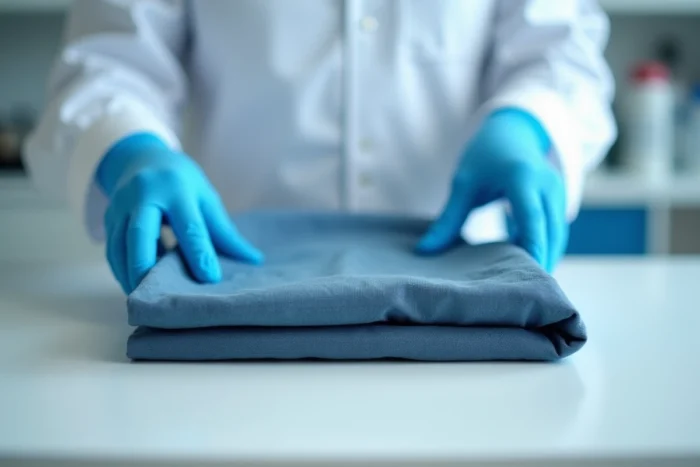
Washing and disinfecting second-hand clothing: actions that eliminate risk
A machine wash at 60 °C eliminates almost all pathogens present on a textile, including scabies mites and fungal spores. For delicate garments that cannot withstand this temperature, freezing for several days is an effective alternative against bedbugs.
Disinfectant products suitable for laundry (based on sodium percarbonate or textile virucidal solutions) complement the mechanical action of washing. Complete drying, ideally in a high-temperature dryer, adds an additional barrier.
Points of vigilance when purchasing
Underwear and swimwear deserve special attention: systematic washing before first wear, at the maximum temperature tolerated by the fabric. Garments with suspicious stains or a persistent odor after washing should be discarded. Wool or silk items, which are more difficult to disinfect at high temperatures, can be treated by freezing followed by gentle washing.
The majority of thrift stores and online resale platforms do not guarantee any prior treatment of items. The responsibility for washing falls on the buyer, and it is this simple action that transforms a theoretical risk into a non-event in terms of health.
The real danger of second-hand clothing does not lie with STIs. It is found in parasites and fungi, against which a washing machine cycle is sufficient. Confusing STIs and skin infections fuels a disproportionate fear that is not based on any documented clinical cases. Washing before wearing remains the only precaution that matters.