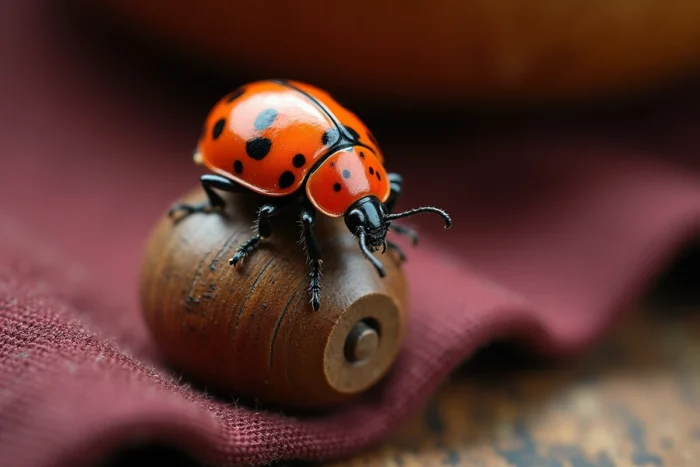
Harmonia axyridis is not the ladybug of nursery rhymes. In cultural entomology, we observe that this species embodies a rare paradox: revered in its Asian native range, rejected in its European and North American introduction zones. The Asian ladybug blurs the symbolic reading grids inherited from the seven-spotted ladybug, and it is precisely this discrepancy that makes its spiritual analysis richer than that of its European cousin.
Harmonia axyridis and the symbolic shock between East and West
The taxonomic distinction between Harmonia axyridis and Coccinella septempunctata is not a mere naturalistic detail. It conditions two incompatible spiritual readings. In China, the Asian ladybug remains associated with wealth and material success. Modern spiritual interpretations link it to prosperity, continuing a tradition where any insect related to agricultural crops carries a positive charge.
In Europe, the shift is stark. Since its introduction as a biological control agent, Harmonia axyridis has established itself as a invasive species perceived as harmful. Massive invasions in homes during autumn have shifted its perception from that of a lucky charm to that of an unwanted presence. France is no exception: reports are multiplying, and the protective symbolism traditionally granted to ladybugs does not transfer there.
This cultural contrast deserves exploration to understand the spiritual meaning of the Asian ladybug without confusing it with that of the classic “God’s creature.” We are not talking about the same insect, and the beliefs associated with them are not interchangeable.

Black ladybug with red spots: an inverted symbolism
Harmonia axyridis exhibits a chromatic variability that the seven-spotted ladybug does not have. Some forms display a black coat with red spots, while others are orange with a variable number of spots. This polymorphism has direct consequences on spiritual interpretations.
The black form with red spots triggers radically different readings from those associated with the classic red. In several contemporary esoteric traditions, black is linked to protection against negative energies, introspection, and sometimes a warning. Red, usually a symbol of love and vitality, becomes secondary, occasional, almost accidental here.
We recommend not imposing the symbolic grids of the red ladybug onto these dark morphotypes. Practitioners of animal symbolism who treat both identically miss a nuance that Asian traditions have long integrated: the dominant color of the insect shapes the message.
- Red/orange form with black spots: classic reading of luck, prosperity, connection with fire and vitality in Chinese tradition
- Black form with red spots: associated with protection, going through a phase of shadow before renewal, sometimes interpreted as a signal of caution
- Pale orange form without visible spots: linked to creativity and lightness in some contemporary readings, but without a solid traditional anchor
Legend of the ladybug: why it does not apply to Harmonia axyridis
The founding legend of the lucky ladybug in France dates back to the 10th century. A condemned man was said to have been pardoned after a ladybug repeatedly landed on his neck, preventing the executioner from striking. King Robert the Pious saw it as a divine sign.
This legend explicitly concerns the European seven-spotted ladybug. The transfer of this symbolic charge to Harmonia axyridis is a shortcut that we frequently observe in mainstream content, but it does not hold up under scrutiny. The Asian species simply was not present in Europe at that time. It was only introduced in the 20th century for biological control.
In Asia, the foundational narratives are different. The ladybug is more closely linked to agricultural cycles and the abundance of harvests than to a specific divine intervention. The dimension of spiritual protection exists, but it is framed within a relationship to the natural world that is less anthropocentric than the European Christian legend.

Beliefs related to the Asian ladybug in the home
When Harmonia axyridis enters a home in autumn, it is not seeking to deliver a message. It is looking for shelter for the winter. However, the spiritual dimension attributed to this domestic intrusion varies significantly across cultures.
- In China, an insect entering the house spontaneously is often read as a sign of imminent prosperity, especially if it lands calmly
- In Eastern Europe (Lithuania, Croatia, Slovenia), a ladybug landing on a person would carry a message from a loved one, a belief that does not distinguish between species
- In North America and Western Europe, massive gatherings of Harmonia axyridis on facades and in attics have largely eroded any positive reading, replaced by a perception of nuisance
The species has lost its positive spiritual charge where it has become invasive. This is a documented phenomenon in cultural entomology: excessive familiarity with an insect, especially when accompanied by inconveniences (odor, stains, light bites), neutralizes the symbolic dimension.
The case of autumn aggregations
The aggregations of Harmonia axyridis on sunny walls before winter are sometimes interpreted in esoteric circles as a sign of community, of gathering energies. This reading is recent and does not rely on any ancient tradition. It illustrates the contemporary tendency to spiritualize banal entomological behaviors.
The Asian ladybug remains a fascinating case study for those interested in the construction of symbols. The same insect carries opposing meanings depending on the continent, and its symbolism evolves in real-time under the pressure of ecological factors. No other ladybug species concentrates as much tension between inherited myths, contemporary beliefs, and biological reality.