The length of a kimono’s sleeves is not merely an aesthetic whim. It encodes the marital status, age, and degree of formality of the wearer. Understanding this system requires tracing the evolution from the kosode to the furisode, and then following the variations in cut that persist in the Japanese ceremonial wardrobe.
Kosode, furisode: the textile mechanics behind sleeve lengthening
The kosode (小袖, “small sleeves”) is the prototype of the kimono as we know it. Its sleeve opening remains narrow, functional, and suited for daily work. The structure is strictly linear: rectangles of fabric folded and sewn without ever being recut.
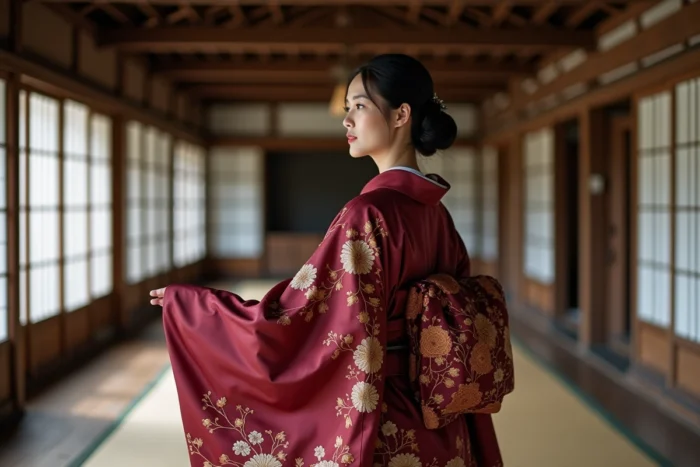
The transition to the furisode (振袖, “swinging sleeves”) marks a functional break. The lengthening of the sleeves does not alter the basic cut of the garment, which remains an assembly of straight panels. What changes is the surface of fabric left hanging under the arm, sometimes nearly touching the ground.
This logic is also detailed on the kimono sleeves on Mademoiselle Camille, where the evolution from kosode to furisode is documented with precision.
This hanging fabric has a direct consequence on movement. Each arm movement produces a wide swing, visible from afar. In a ceremonial context, long sleeves amplify the silhouette and dramatize gestures, transforming the wearing of the garment into a coded body language.
Furisode sleeves and marital status: a strict dress code
The furisode is reserved for young unmarried women. This is the point that most mainstream articles treat as a mere folkloric detail, while it constitutes the core of the system.
The length of the sleeves functions as a social marker recognizable by all participants in a ceremony. Three levels of length distinguish the variants of the furisode:
- The ko-furisode, with moderately long sleeves, worn in semi-formal contexts by young women
- The chu-furisode, intermediate, common during coming-of-age ceremonies (seijin shiki)
- The o-furisode, whose sleeves reach their maximum length, reserved for the most solemn occasions such as weddings
After marriage, a woman transitions to the tomesode, which has significantly shorter sleeves. This shortening is not gradual: it corresponds to a change in social category. Historically, cutting one’s long sleeves signaled the transition to the status of wife.
Homongi and tomesode: hierarchy through sleeves
The homongi (“visiting garment”) occupies an intermediate position. Its sleeves are longer than those of the tomesode but shorter than those of the furisode. It can be worn by married or unmarried women, making it a partial exception to the long sleeve/unmarried code.
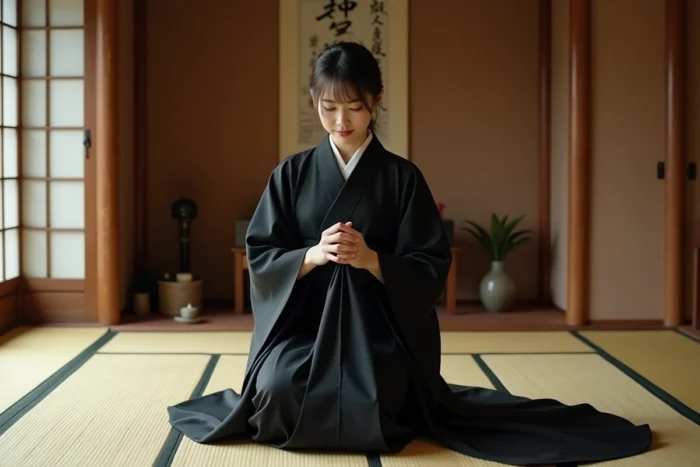
The kurotomesode (black tomesode), the most formal kimono for married women, features short sleeves and patterns concentrated below the waist. The simplicity of the sleeve here indicates maturity and family rank.
Fabric, silk, and cutting constraints: why length has persisted
A traditional kimono is constructed from a tan, a roll of fabric with standardized width. This fixed width constraint imposes a limited vocabulary of shapes. Lengthening the sleeve does not require structural modification of the cut: it is enough to let more fabric hang below the armhole.
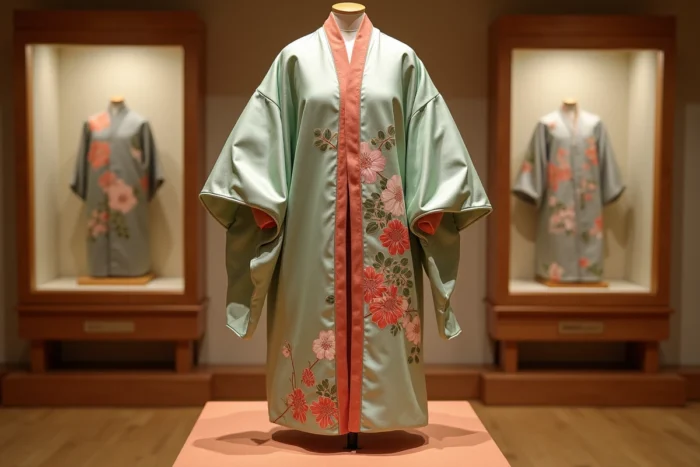
Silk, the preferred material for formal kimonos, enhances the movement of long sleeves. Its fluidity and light weight produce a natural drape that stiffer fibers would not allow. Patterns painted or woven gain visibility on this extended surface, encouraging artisans to treat the sleeves as true decorative panels.
Colors also play a role in this system. On a furisode, bright hues and floral patterns cover the entire garment, sleeves included. On a tomesode, the decoration is limited to the bottom of the kimono. The long sleeve thus offers additional space for ornamental expression, reserved for social categories permitted to wear this garment.
Ceremonial kimono and Western fashion: a frequent confusion about sleeves
Western fashion regularly borrows the silhouette of the kimono, including its wide sleeves. These adaptations retain the shape but eliminate the function. A garment labeled “kimono” in Western ready-to-wear does not adhere to any of the sleeve length codes that govern the Japanese wardrobe.
This transposition creates confusion between visual style and cultural meaning. Wearing “Japanese-style” long sleeves in a Western context conveys no information about status or age. The garment loses its linguistic dimension.
In Japan, the kimono is now worn almost exclusively on festive or special occasions. This withdrawal from daily use has paradoxically reinforced the symbolic dimension of long sleeves: they appear in contexts where every detail of clothing is laden with meaning, such as weddings or ceremonies related to the summer yukata at festivals.
- The furisode remains the most photographed kimono during the seijin shiki, the coming-of-age ceremony
- The sleeves of the o-furisode reach their maximum length precisely because the event demands maximum social visibility
- The obi (wide belt) interacts with the long sleeve to structure the silhouette: the longer the sleeve, the higher the obi must be tied to maintain visual balance
The length of kimono sleeves has never been gratuitous ornamentation. It remains, in contemporary Japan, a immediate social reading cue for anyone who masters the traditional dress code. Every centimeter of fabric hanging under the arm tells a story of status, age, and circumstance.