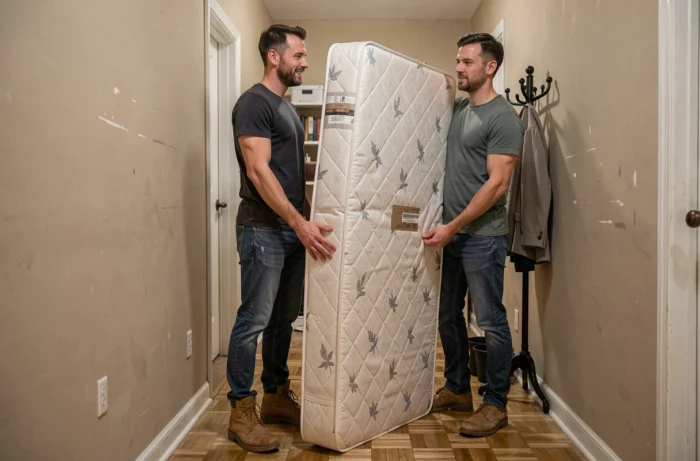
A 140×190 bed base weighs between twenty and forty kilograms depending on the model, and its dimensions make it difficult to maneuver in a narrow hallway or stairwell. Transporting this type of bedding poses concrete issues of size, weight, and road regulations that most moving guides overlook.
Maximum load on the roof and toll class upgrade: what the highway code requires
Before hoisting a bed base onto a roof rack, it is essential to check the permissible load. The generally accepted limit on the roof is 75 kg (including bars, box, and load), a threshold reiterated by car manufacturers. A rigid upholstered bed base in 140×190 may approach or exceed this limit once the weight of the roof bars themselves is added.
The French regulations on securing loads add a constraint that is often ignored. The articles of the highway code related to loading require that it be securely fastened and not dangerously protrude. The EN 12195 standard, which governs securing and anchoring devices, serves as a professional reference for calculating the necessary retention force. A poorly strapped bed base on a car roof can slide during sudden braking and pose a real danger.
Another little-known point: the optical sensors at tolls measure the highest point of the vehicle. A bed base secured on the roof can trigger a misclassification to class 2, charged incorrectly. Drivers who have attached a roof box have already been reclassified after a complaint via the intercom at the toll booth. The same scenario applies with a bed base. Keeping your toll ticket and immediately reporting the issue remains the only solution.
Knowing how to transport a 140×190 bed base easily requires understanding these constraints before choosing a mode of transport.

Upholstered bed base, slatted bed base, or kit bed base: transport preparation varies
The type of bed base determines the transport strategy. A removable slatted bed base reduces to a flat frame and a pack of slats. The whole fits into a station wagon or minivan without major difficulty. It is enough to number the pieces and group the screws in a labeled bag.
An upholstered bed base, on the other hand, forms a rigid block that cannot be folded. Its dimensions in 140×190 exceed the capacity of most sedan trunks. Removing the legs saves a few centimeters in height, but does not change the length and width. A utility vehicle remains the most reliable solution for this size.
The kit bed base, designed for transport, disassembles into compact panels. This is the least restrictive format, provided you have the manual for reassembly. Losing an assembly guide turns a time-saving into a headache.
Protecting the bed base during transport: cover, straps, and padding
Protecting the bed base is not just about avoiding scratches. A shock during transit can warp the frame, break a slat, or tear the fabric of an upholstered bed base. Three protective elements deserve special attention:
- A specific protective cover for bedding, made of thick plastic or non-woven fabric, that covers the entire bed base and protects it from moisture, dust, and friction against the vehicle’s walls.
- Ratchet straps (and not just simple ropes) to secure the bed base in the utility vehicle or on the roof rack. The tension must be sufficient to prevent any lateral slipping during turns, without deforming the frame.
- Blankets or foam pads placed between the bed base and the metal walls of the truck, which absorb vibrations and prevent direct friction on hard surfaces.
A bed base secured vertically in a utility vehicle takes up less floor space, but this position requires reinforced securing. The bed base laid flat and strapped to the floor offers the best stability if space allows.

Physical risks and handling techniques for a 140×190 bed base
Lifting and moving a bulky object like a 140×190 bed base exposes the back, shoulders, and wrists to mechanical stresses comparable to those of a poorly designed handling job.
Gripping an upholstered bed base presents a specific problem: the lack of handles. Fingers slip on the fabric, leading to excessive bending of the back. Using carrying straps passed under the bed base and raised over the shoulders redistributes the load and frees the hands to stabilize direction.
For buildings without elevators, navigating landing corners remains the critical moment. The bed base must be tilted, pivoted, and then straightened in a space often too narrow for two people side by side. Measuring the width of the stairwell and doorways before the transport day avoids blockages during the effort.
If the dimensions do not fit, renting a furniture lift becomes the only viable option. This service is offered by specialized providers in urban relocations.
Transporting a 140×190 bed base without damage or injury relies on methodical preparation: identifying the type of bed base, choosing the appropriate vehicle, correct protection, and anticipating the physical obstacles of the journey. A detail overlooked in advance can cost time lost or repairs on moving day.