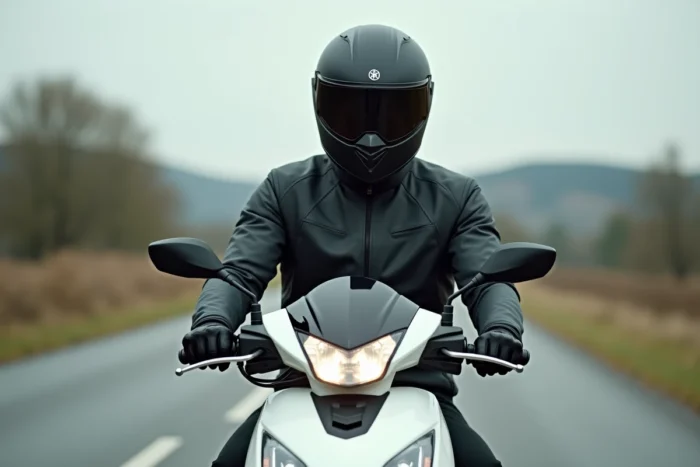
The Yamaha XMAX 125 comes from the factory with a power limited to 15 horsepower, in accordance with regulations applicable to scooters accessible with an A1 license or a B license completed by a seven-hour training course. This power limit directly affects the maximum achievable speed. Modifying this parameter, even slightly, pushes the vehicle outside its homologation framework.
Difference between legal A2 derestriction and modification of a 125
A technical point that is often confused deserves to be stated upfront. The French administration allows, under strict conditions, the derestriction of an A2 category motorcycle (restricted to 35 kW) to its full power version, provided that the model exists in an unrestricted version, that the transformation is planned by the manufacturer during European approval, and that the vehicle is equipped with ABS.
The XMAX 125 does not fall within this framework. There is no “full power” version beyond 15 horsepower in the Yamaha catalog for this engine size. Derestricting a XMAX 125 does not fall under any legal transformation regime. Owners who are wondering about the maximum speed of the derestricted XMAX 125 must take this distinction into account before any other consideration.
In practical terms, the legal derestriction procedure requires having the vehicle modified by a professional, and then updating the registration document within a month. This administrative process has simply not been designed for 125 cm³, whose maximum authorized power already corresponds to that of the original vehicle.
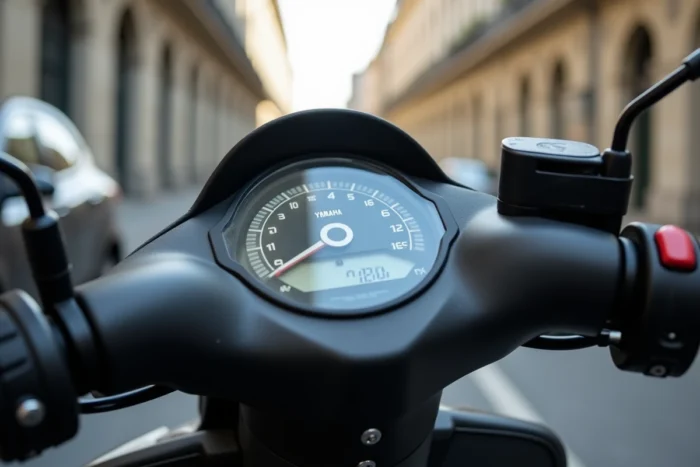
Speed of the derestricted XMAX 125: what to expect in practice
Several testimonials and specialized content mention speed gains after removing mechanical restrictions or reprogramming the ECU on a XMAX 125. The most common modifications involve the variator, the exhaust, or the injection mapping.
The actual gain remains modest. A 125 cm³ single-cylinder engine reaches its physical limits quite quickly, regardless of the level of modification. The top speed may increase by a few km/h, but the engine then operates at RPMs for which it was not designed, which accelerates the wear of internal components.
Load and real conditions
Several unofficial sources highlight that the comfortable cruising speed significantly decreases when riding two-up or with luggage, even on a perfectly stock XMAX 125. Adding a passenger and a top case noticeably reduces perceived performance.
On a derestricted model, this loss is amplified: the engine, already pushed beyond its factory parameters, handles the overload less effectively. The idea of a 125 scooter capable of high-speed riding under all circumstances after derestriction is more of a fantasy than a mechanical reality.
Sanctions and concrete consequences of derestricting a 125 scooter
French regulations strictly prohibit modifying the technical characteristics of a vehicle to the point of making it non-compliant with its certificate of approval. For a 125 scooter, this covers any intervention that increases power or speed beyond the homologated values.
The consequences in case of a check are not limited to a fine. The administration explicitly mentions three levels of sanction:
- Fine for putting a non-compliant vehicle into circulation, which may be accompanied by a separate penalty depending on the nature of the observed modification.
- Immediate immobilization of the scooter by law enforcement, with an obligation to bring it back into compliance before any resumption of circulation.
- Towing of the vehicle, a measure applied when simple immobilization is insufficient or when the driver cannot justify a rapid restoration.
This last point is rarely detailed in online content. Towing incurs daily storage fees and requires an administrative procedure to recover the vehicle, turning a simple roadside check into a costly and time-consuming situation.
Insurance invalidated after derestriction
Any undeclared modification that alters the vehicle’s performance constitutes a false declaration to the insurer. In the event of a claim, the insurance may refuse any compensation, including for bodily injuries suffered by the driver or a third party.
The mechanism is simple: the contract covers a XMAX 125 homologated at 15 horsepower. If post-accident inspection reveals a higher power or non-compliant parts, the contract is considered void. The driver then becomes financially responsible for all damages.
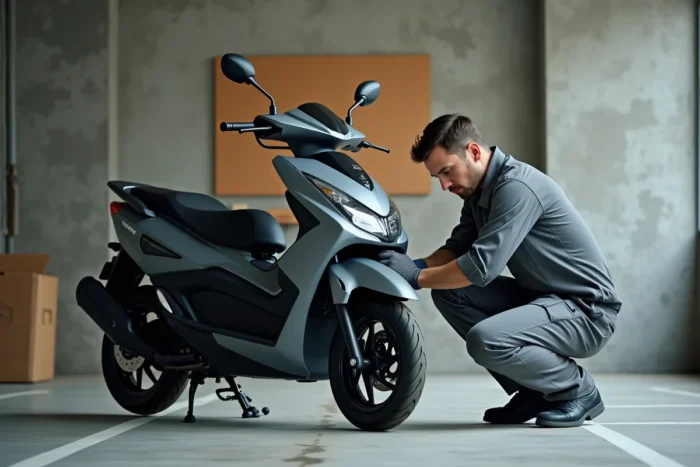
Two-wheeler technical inspection and detection of derestriction
The technical inspection of motorized two-wheelers, now in effect in France, focuses on the general compliance of the vehicle. For a XMAX 125, the regulatory risk does not come from a speed measurement on a test bench during the inspection, but from checking the compliance of visible elements: original exhaust, absence of non-homologated aftermarket parts, consistency between the registration document and the actual state of the scooter.
A modified exhaust or an additional electronic control unit may be enough to trigger an unfavorable opinion. Compliance must then be restored before a re-inspection, under penalty of no longer being able to circulate legally.
The technical inspection does not detect all internal modifications (ECU reprogramming, for example), but it creates a regular checkpoint where the vehicle is examined. Combined with random roadside checks, it reduces the window in which a derestricted scooter can operate without being detected.
The potential speed gain on a derestricted XMAX 125 remains low compared to the legal, financial, and mechanical risks. A compliant, well-maintained, and properly ridden 125 scooter offers sufficient performance for the urban and suburban use for which it is intended. Any power modification places its owner in a situation where the slightest check or accident can have disproportionate repercussions compared to the gain of a few km/h.