On a high-end sports car that is four to seven years old and properly maintained, the annual maintenance cost often approaches that of a classic premium vehicle. The budget explosion occurs when major components fail due to negligence, not mechanical fate. Some technical adjustments allow for keeping the bill under control without sacrificing performance or reliability.
SRA Ranking and Repair Costs: Choosing Your Sports Car with Knowledge
The SRA scale, used by French insurers, ranks brands according to the average repair cost across more than 400 models. Porsche, Alpine, Dodge, and Land Rover are among the most expensive brands to repair, with the Porsche Cayenne at the very top of the ranking.
This scale directly affects the insurance premium, but it also reflects the price of original parts and the labor time in authorized workshops. Before purchasing, cross-referencing the SRA index of the targeted model with the availability of parts in the independent market provides a realistic idea of the recurring budget.
We recommend comparing models within the same brand. At Porsche, a Boxster or a Cayman with a naturally aspirated flat-six engine costs significantly less in regular maintenance than a Cayenne V8 turbo. Acquiring a used Porsche well-positioned in the SRA hierarchy mechanically reduces the annual bill right from the insurance subscription.
Engine Oil and Oil Change Intervals: Where Misplaced Savings Can Be Costly

A high-end sports car engine operates at RPMs and temperatures that a sedan never experiences. A delayed oil change on a high-performance engine degrades the oil well before the manufacturer’s deadline, especially in mixed city-highway use with short warm-up phases.
The manufacturer’s interval is calibrated for “average” use. On a GT used for short trips or regular sporty driving, shortening the interval by a third protects the bearings and the timing without representing a significant extra cost. The price of approved oil (often a 0W-40 or 5W-50 depending on the brand) varies from simple to double between the official network and an independent workshop using the same certified grade.
We observe that many owners confuse “premium” oil with “approved” oil. Only the manufacturer’s standard matters (LL-01, A40, C3, etc.). A can bearing the correct approval bought at an auto center serves exactly the same purpose as a can billed at the dealer’s rate.
Braking and Tires on High-End Sports Cars: Choosing Between Original and Equivalent
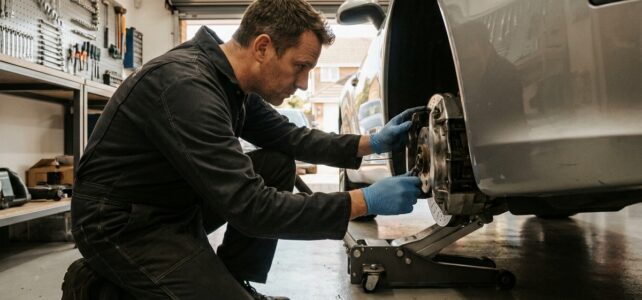
Original pads and discs often bear the manufacturer’s brand but are made by third-party suppliers. Identifying the actual manufacturer (Brembo, AP Racing, Textar) allows for ordering the equivalent reference for a fraction of the price.
- Carbon ceramic pads: reserved for regular track use. In road use, high-quality OE semi-metallic pads offer equivalent braking with reduced disc wear.
- Ventilated drilled discs: replacing with slotted ventilated discs (without drilling) decreases the risk of cracking while maintaining thermal dissipation.
- Tires: switching from an ultra-high-performance tire (UHP category) to a high-end sport touring tire significantly lowers the annual budget, with measurable grip loss only beyond legal limits on open roads.
On models equipped with factory carbon-ceramic brakes, complete replacement represents a considerable cost. As long as the discs do not show through cracking or critical thickness loss, a simple pad change extends their lifespan by several tens of thousands of kilometers.
Projected Budget: Anticipating Critical Mileage Thresholds
Budgeting up to 3,000 euros per year is prudent as the vehicle ages and when incorporating the gradual replacement of wear components (shock absorbers, bushings, water pump, ignition coils). This amount is not exceptional compared to certain premium sedans whose onboard electronics generate similar bills.
We structure the budget around three critical mileage thresholds:
- Before the first manufacturer threshold (often around the fourth or fifth year): regular maintenance, oil changes, filters, pads. The cost remains moderate.
- At the intermediate threshold: timing belt or chain depending on the engine, clutch on manual or automated gearboxes, shock absorbers. This is when an unprepared owner discovers the bill.
- Beyond: air suspension (if equipped), turbo, gearbox. At this stage, the relationship with a specialized independent workshop makes all the difference compared to the official network.
Authorized Workshop or Independent Specialist: Real Impact on the Bill
The end of the manufacturer’s monopoly on maintenance, confirmed by European regulations on selective distribution, opens access to technical data for independent workshops. A specialist equipped with the manufacturer’s diagnostic tool and supplying OE parts regularly charges an hourly rate that is 30 to 50% lower than the official network.
The point of caution concerns the contractual warranty. As long as maintenance is performed according to the manufacturer’s plan with equivalent quality parts, the legal warranty cannot be refused on the grounds of off-network maintenance. Keeping each detailed invoice with part references is sufficient to prove in case of a dispute.
The last often-overlooked lever: storage. A sports car left outside during winter accumulates condensation in the exhaust, corrosion on the discs, and degradation of the seals. A simple covered shelter, even unheated, reduces these degradations and the costs of restoration in spring. Maintaining a high-end sports car is primarily a matter of anticipation, not resignation in the face of estimates.