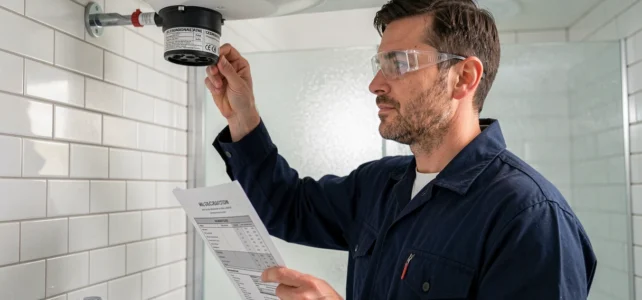
Protection class and IP rating refer to two distinct properties of a luminaire, measured by different tests and governed by separate standards. Confusing the differences between class 2 and IP44 is akin to comparing an electrical insulation strategy with a level of resistance to foreign bodies and water. This article places both standards side by side to clarify what each marking guarantees when choosing indoor or outdoor lighting.
Protection class and IP rating: two distinct technical references
The protection class (I, II, or III) exclusively concerns electrical safety. It defines how the luminaire protects the user from contact with live parts. A class I luminaire uses grounding; a class II luminaire relies on double insulation or reinforced insulation, without a ground wire. Class III operates at very low safety voltage.
The IP rating (Ingress Protection) measures something else: the resistance of the enclosure against solids (dust, foreign bodies) and liquids (drops, splashes, jets). The first digit after “IP” indicates protection against solids, while the second indicates protection against water. An IP44 luminaire resists solid objects larger than one millimeter and water splashes from all directions.
A device can therefore be class II and IP20 (no water protection), or class I and IP65 (waterproof against jets). The two markings complement each other; they never substitute for one another. To delve deeper into the differences between class 2 luminaires and IP protection, each criterion must be analyzed separately before cross-referencing them.
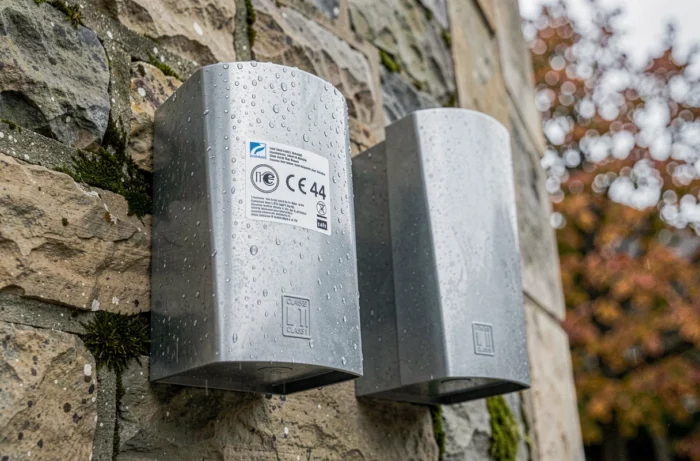
Comparison table: class II versus IP44 criterion by criterion
| Criterion | Class II | IP44 |
|---|---|---|
| Reference standard | IEC 61140 (electrical safety) | IEC 60529 (enclosure protection) |
| What the marking measures | Insulation against electric shocks | Sealing against solids and water |
| Grounding requirement | Not required (double insulation) | Irrelevant (depends on class) |
| Dust protection | Not covered | Particles larger than 1 mm blocked |
| Water protection | Not covered | Water splashes from all directions |
| Symbol | Double concentric square | Label “IP44” |
| Typical standalone use | Living room, bedroom, dry interior | Outdoor sheltered luminaire, bathroom zone 2 |
This table shows that the two markings cover entirely different risks. A class II luminaire installed outdoors without an appropriate IP rating will not withstand the elements, even if its electrical safety is impeccable.
When a luminaire combines class II and IP44: concrete installation cases
In a bathroom, the NFC 15-100 standard imposes a minimum IP rating depending on the zone. Zone 2 (beyond the shower or bathtub, within a determined radius) requires at least an IP44 luminaire. If this luminaire is also class II, it eliminates the need for grounding, simplifying wiring in damp areas where the ground wire may pose passage constraints.
In a covered outdoor area (porch, awning, covered terrace), IP44 lighting is sufficient against lateral rain splashes. Combining class II with this rating removes dependence on the ground circuit, an advantage in older installations lacking a reliable protective conductor.
- Bathroom zone 2: a class II + IP44 luminaire protects against electric shock and splashes, without requiring a ground
- Kitchen near the sink: water splashes justify a minimum IP44, and class II avoids dependence on a ground connection that may be absent in older buildings
- Covered terrace or balcony: IP44 blocks droplets carried by the wind, class II secures the user even if the outdoor installation lacks grounding
On the other hand, a luminaire that is only class II without a sufficient IP rating has no place in these environments. Double insulation protects against current, but not against corrosion or water infiltration into the power supply block.
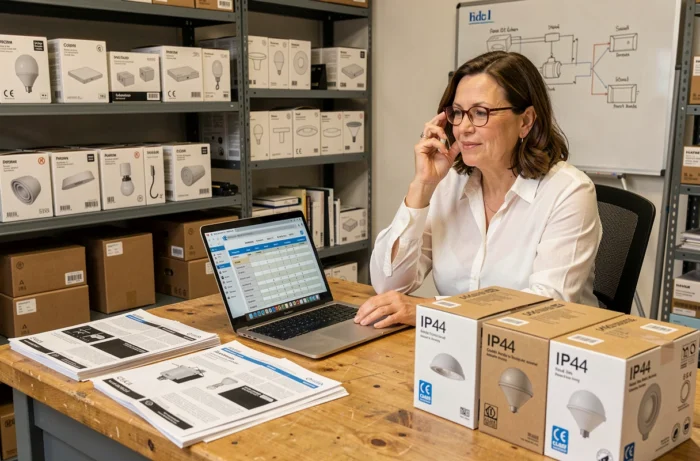
Common mistakes when choosing between class II and IP44
The most common confusion is believing that a class II luminaire is automatically moisture-resistant. The double concentric square guarantees electrical insulation, nothing more. A class II ceiling light installed above a shower without an appropriate IP rating will expose its internal components to steam and splashes.
The reverse error also exists: choosing an IP44 class I luminaire for a bathroom without checking for a functional ground conductor. Water protection is ensured, but electrical safety then relies entirely on wiring that may be faulty.
Another trap: confusing IP44 and IP65. An IP44 luminaire resists splashes, not direct jets. For lighting subjected to jet cleaning or installed outdoors without shelter, an IP65 rating or higher is required. The protection class does not change this requirement.
Reading a luminaire label: identifying class and IP rating before purchase
The symbol for class II (two interlocking squares) appears on the luminaire label or in its technical documentation. It does not always appear on the commercial packaging, highlighting the importance of consulting the product sheet. The IP rating is mentioned in the form “IPXX” directly on the luminaire body or its packaging.
- Check for the double square to confirm class II
- Read the two digits after “IP”: the first for solids, the second for liquids
- Cross-reference both pieces of information with the intended installation area (dry interior, damp room, covered outdoor, exposed outdoor)
- Check compatibility with the type of bulbs or LED spots planned, as some modules generate heat that alters the sealing behavior
A suitable luminaire combines the right class and the right IP rating for its location. Treating these two parameters as interchangeable remains the most frequent source of error, whether for a living room wall light or recessed spots in a damp area.