
The awakening of a baby cannot be scheduled like a private lesson. Recent research on sensorimotor development shows that the most fruitful moments for an infant are those when we follow their signals, not a pre-established schedule. Yawning, averted gaze, restlessness, or attentive calm: these cues guide each interaction far better than a timetable. This article compares the awakening and well-being levers for babies based on their real impact, age by age.
Baby signals versus fixed schedules: what the observational approach changes
Most content on baby awakening offers lists of activities categorized by age group. The problem: they assume that the infant is available at the moment the adult decides to play.
Recent recommendations explicitly prioritize the baby’s signals to organize awakening phases. A newborn who looks away or brings their hands to their face signals sensory saturation. Continuing stimulation at this stage produces the opposite effect of what is sought.
Observing yawns, gaze, and restlessness before proposing an activity changes the game. A parent who identifies a calm awakening window (eyes open, smooth movements, directed attention) has a few minutes to interact. This window varies from child to child and from day to day. Catalogs of articles suitable for each developmental phase are available on lol-baby.be, allowing for the selection of materials based on the child’s actual stage rather than their theoretical age.
Visual stimulation of the newborn: black and white contrasts and presentation distance
The visual system of a newborn is immature. Their clear vision is limited to a very short distance, roughly that which separates the parent’s face from theirs during breastfeeding or bottle-feeding.
Black and white contrast remains the most documented visual awakening lever for the first weeks. High-contrast images capture the infant’s attention because their retina does not yet distinguish pastel colors or subtle shades.
| Visual awakening lever | Optimal period | Condition for effectiveness |
|---|---|---|
| High-contrast black and white images | Birth – 2 months | Presentation at close distance from the face |
| Contrasting colored objects (red, bright yellow) | 2 – 4 months | Slow movement in the visual field |
| Unbreakable mirror on the floor | 3 – 6 months | During tummy time, at eye level |
| Cardboard books with large images | 5 months and older | Free manipulation by the baby |
Presenting contrasts too far from the face reduces their impact to almost nothing. The frequent reflex of hanging a black and white mobile from the ceiling moves the stimulus away from the infant’s area of clarity. It is better to hold a contrasting cardboard close by during a calm awakening window.
Tummy time: daily progression and common mistakes
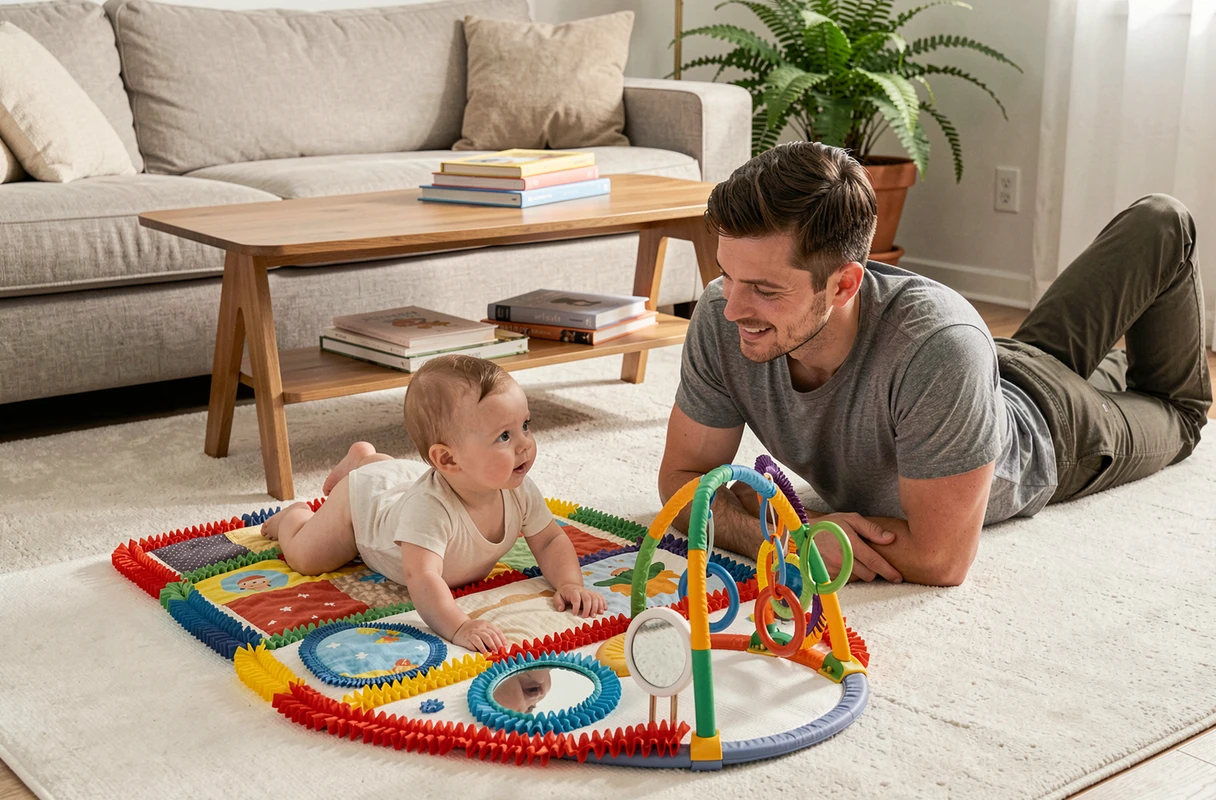
Tummy time (time spent on the stomach, awake and supervised) is often presented as a session to be planned. Recent data nuance this approach: it consists of brief and repeated moments, integrated into awakening phases, not a long-duration exercise.
A newborn sometimes tolerates less than a minute on their stomach before showing discomfort. Forcing the duration generates stress without additional motor benefits. Progress occurs naturally over several weeks as the neck and trunk muscles strengthen.
- Placing the baby on the parent’s stomach (skin-to-skin or clothed) already counts as tummy time and reassures more than a mat placed on the floor
- Alternating surfaces (firm play mat, folded towel, parent’s chest) avoids monotony and stimulates different supports
- Offering a visual stimulus at eye level (parent’s face, contrasting toy) motivates the baby to lift their head without needing verbal prompting
Tummy time on the parent is as effective as on a mat for the first weeks. This variant reassures families who notice their infant cries immediately on the floor.
When tummy time poses a problem
A baby who systematically refuses the prone position after several weeks of gradual attempts deserves evaluation by a healthcare professional. A postural torticollis or undetected cervical tension may explain this rejection.

Daily care as awakening moments: changing, bathing, and dressing
Skin-to-skin contact and verbal interactions during routine care constitute full awakening moments. Changing, bathing, and dressing are not just hygiene gestures: they simultaneously engage the baby’s touch, hearing, and proprioception.
Naming each body part during changing, slowing down actions to allow the infant to anticipate what comes next, maintaining eye contact: these micro-interactions build sensory references without additional materials.
- During bathing, allowing the baby to touch the water with their hands before immersing them activates their tactile perception and reduces surprise reactions
- When dressing, gently guiding an arm into the sleeve rather than pulling allows the baby to perceive joint movement
- Talking to the baby while describing actions (“I’m lifting your leg, I’m putting on the diaper”) structures the routine around language
Daily care offers as much sensory stimulation as a play toy, provided the adult slows down and verbalizes. The advantage: these moments occur several times a day, without additional organization.
Choosing baby awakening materials: concrete criteria
The childcare market offers a considerable amount of toys labeled “awakening.” Not all are equal, and the price does not reflect developmental relevance.
A good awakening object for an infant meets three conditions: it is safe (no small parts, non-toxic materials), it is simple (one or two sensory functions, not an overload of sounds and lights), and it corresponds to the child’s actual developmental phase.
An object too complex for the baby’s stage will be ignored or generate frustration. A textured teething ring, a lightweight rattle, a crinkly fabric often provide more than a multifunctional activity board offered too early.
The most reliable criterion remains observation: if the baby manipulates the object, brings it to their mouth, looks at it attentively during their awakening windows, the material serves its purpose. Otherwise, it is better to put it away and offer it again a few weeks later.