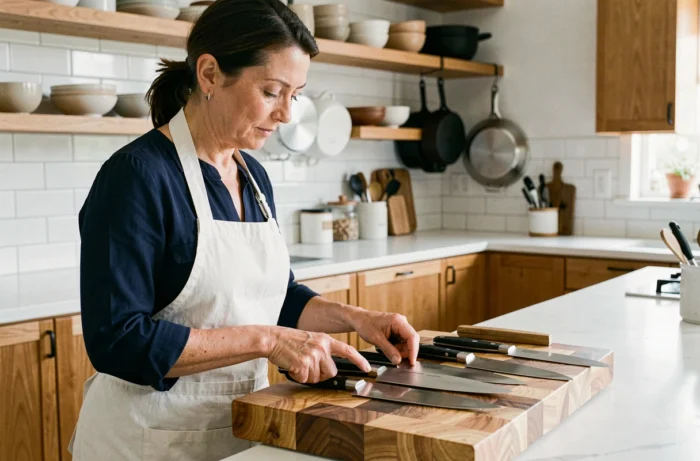
A decent chef’s knife, a pan that holds temperature, and a stable cutting board handle most situations in home cooking. The rest often falls into the category of gadgets or impulse buys. Here, we review the equipment choices that truly make a difference in the results on your plate, excluding duplicates and single-use utensils.
Thermometer and digital scale: precision tools that change cooking
Cooking by eye works for a quick stir-fry, but not for a whole poultry or a hydrated dough. The instant-read thermometer eliminates guesswork about the doneness of meat or caramel. We recommend a model with a thin probe that responds in seconds, rather than a slow, bulky dial thermometer.
The digital scale, on the other hand, ensures reproducibility. In baking, a difference of a few grams of yeast or butter alters the final texture. In savory cooking, weighing your seasonings (salt, spices, miso) avoids last-minute corrections. These two instruments are inexpensive and immediately elevate the consistency of results.
To complement this approach, you can discover the equipment on Les Coudes sur la Table and compare ranges suitable for demanding home use.
Chef’s knife and cutting board: the technical duo not to be overlooked
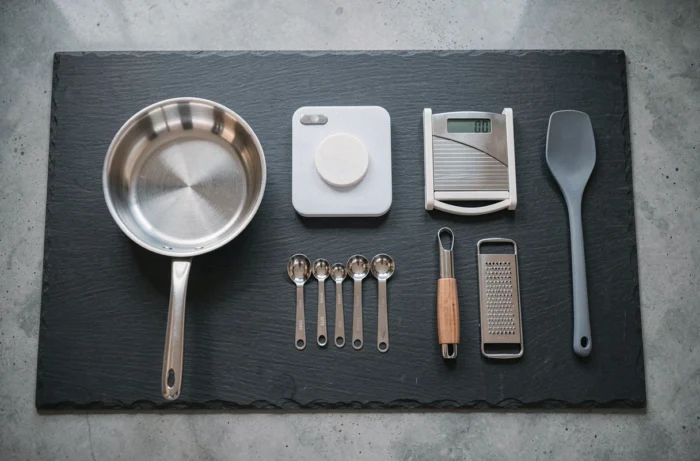
A single versatile chef’s knife, with a blade between 20 and 24 cm, covers almost all cutting tasks: slicing, dicing, chopping, and carving. Paring and bread knives complement it, but they never replace the main knife. The difference between a European forged blade and a Japanese blade mainly lies in the sharpening angle and the hardness of the steel.
A Japanese blade often descends to a tighter angle, giving a finer edge but requiring regular maintenance on a whetstone. A classic Western blade withstands lateral impacts better (crushing garlic, splitting a pumpkin). The choice depends on the dominant cutting style in your practice.
At least two cutting boards for food safety
We observe that cross-contamination remains underestimated in home kitchens. Designating one board for raw meats and fish, and another for vegetables significantly reduces risk. Hard wood boards (maple, beech) or thick composite materials are preferable to thin, soft plastic models, which warp and scratch quickly.
The stability of the board on the countertop is as important as its material. A damp cloth slipped under the board prevents any movement during cutting, a basic reflex in a professional kitchen.
Frying pan, saucepan, and baking sheet: the cooking trio that covers everything
Three containers are sufficient to cook most everyday dishes:
- A carbon steel or thick stainless steel frying pan of 28 cm. Carbon steel develops a patina over time and offers thermal response similar to cast iron, without the weight. Triple-layer stainless steel is better suited for those who prefer minimal maintenance and frequent deglazing.
- A Dutch oven or enameled cast iron pot, capable of going from stovetop to oven. This type of container handles braises, soups, long cooking, and even homemade bread.
- A thick steel baking sheet (rather than the drip tray that comes with the oven). Thick steel retains heat and distributes it evenly, significantly improving the crust of a pizza or roasted vegetables.
Cheap non-stick pans lose their coating after a few months of heavy use. They are suitable for eggs and pancakes, but not as a primary frying pan. It’s better to invest in one reliable cooking container than in a set of five fragile pieces.
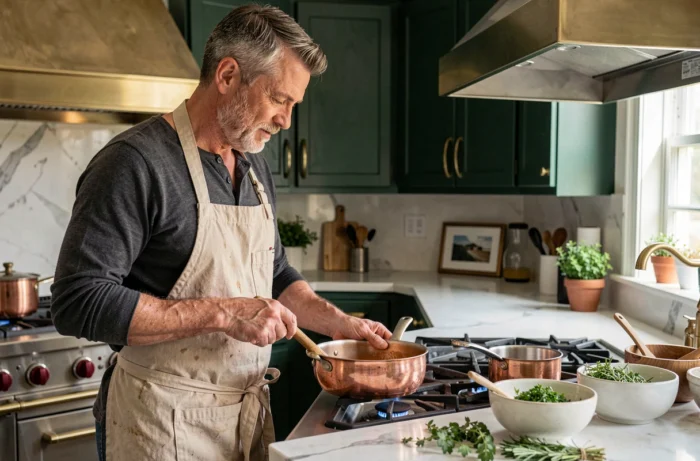
Small preparation accessories: those that streamline service
Finishing and handling utensils are often overlooked in favor of larger equipment. However, they determine the workflow efficiency at the station.
- A kitchen tongs replace spoons, forks, and spatulas in most flipping and plating tasks.
- A heat-resistant silicone spatula allows you to scrape the bottoms of pots without scratching the coating and to fold delicate preparations.
- A fine grater like Microplane transforms citrus zests, garlic, ginger, or parmesan in seconds, achieving a fineness impossible to obtain with a knife.
- A fine mesh strainer serves as much to drain pasta as to sift a sauce or filter a broth.
Each of these accessories is inexpensive, takes up little space, and eliminates a tangible friction in the preparation process. We consider them a priority over a food processor or a steamer, which only intervene in specific uses.
Storage and organization of the station: what separates the amateur from the efficient cook
Equipment is useless if it is poorly organized or if leftovers end up in poorly sealed plastic wrap. Hermetic glass storage containers preserve preparations better, transition from refrigerator to oven, and do not retain odors, unlike plastic.
Organizing the workstation follows the principle of professional mise en place: each ingredient is weighed, cut, and arranged before turning on the heat. This reflex reduces stress, limits measurement errors, and shortens actual cooking time. It requires no additional equipment, just a few bowls and a clear cutting board.
Equipping your kitchen like a chef does not involve accumulating specialized equipment. A limited base of reliable, well-maintained tools suited to your cooking style produces better results than a drawer full of unused accessories. The thermometer, scale, and a good frying pan elevate the level of a dish more than a sous-vide machine used twice a year.