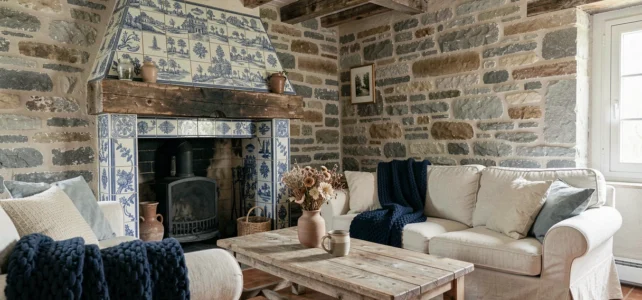
Granite, slate, raw wood: the materials of a Breton house alone dictate an atmosphere. However, between the restored longère and the newly built structure dressed in regional codes, the choices for interior decoration do not involve the same constraints. This article compares the concrete levers that allow for a warm interior in Breton style, distinguishing what pertains to the existing building and what applies to any housing.
ABF Constraints and Exterior Palette in Breton Heritage Areas
Before considering interior decoration, a regulatory point conditions the entire project for houses located near a historical monument or in a remarkable heritage site. Since the end of July 2026, a guide for the energy rehabilitation of buildings of heritage interest specifies the role of the Architects of Buildings of France.
Within a co-visibility perimeter, the opinion of the ABF becomes mandatory for any modification of the exterior appearance: facades, shutters, joinery, fences. The town hall is required to follow this opinion. In practical terms, one can no longer freely choose a shade for shutters or a window material visible from the street if the house is located within this perimeter.
The guide emphasizes respecting local heritage characteristics for solar protections and joinery: shape, materials, and shades must align with the architectural practices of the region. For a Breton house, this leads to wooden shutters painted in traditional tones (navy blue, slate gray, dark green) and excludes white PVC or contemporary roller blinds on the main facade.
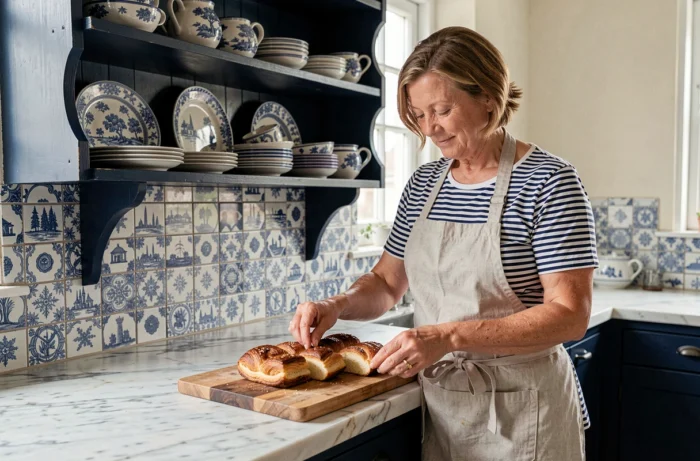
This constraint has a direct effect on the coherence between interior and exterior. Wooden joinery imposed by the ABF creates a visual framework that naturally calls for harmonious interior decoration, whereas aluminum joinery would have pushed towards a more industrial aesthetic. Several decorative elements typical of the house page of Terre de Breizh illustrate this logic of coherence between structural materials and ambiance objects.
Breton Interior Materials: Comparison of Wood, Stone, and Plaster
The choice of interior finishing materials determines the perceived warmth of a room. Three options consistently appear in authentic Breton style projects. Their visual and practical properties differ significantly.
| Material | Visual Effect | Maintenance | Compatible with Old Renovation | Compatible with New Construction |
|---|---|---|---|---|
| Exposed stone (granite, schist) | Raw, massive, cool | Low (joints to monitor) | Yes (stripping of existing walls) | Possible as cladding |
| Wood (beams, paneling, oak flooring) | Warm, bright if light | Medium (treatment, periodic sanding) | Yes (restoration of framework, flooring) | Yes (interior cladding, joists) |
| Natural lime plaster | Soft, matte, breathable | Low | Yes (hygrometric regulation of old buildings) | Yes |
Exposed stone, often granite in Brittany, adds visual mass. However, a wall entirely made of granite in a living space can darken the area and cool the atmosphere if no warm counterpoint balances it.
Limiting exposed stone to one wall per room and treating the others with lime plaster or light wood is the most common approach in successful renovations. Lime plaster has a specific advantage for old buildings: it allows stone walls to breathe, whereas cement plaster traps moisture and accelerates joint degradation.
Wood as the Common Thread of Breton Decoration
Wood plays a structural (beams, framework) as well as decorative role. In a longère, the existing beams become a central decorative element once stripped and treated. In a new construction, added oak or chestnut beams reproduce this effect.
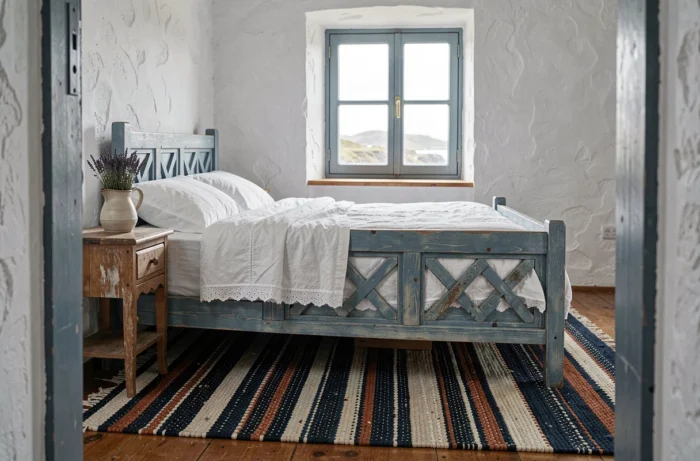
Chestnut remains the historical wood of Breton furniture: wardrobes, closed beds, chests. Integrating one or two pieces of traditional chestnut furniture into an otherwise contemporary interior creates a contrast that anchors the style without tipping into a museum-like reconstruction.
Color Palette for a Warm Breton Interior
The colors of a Breton house are directly inspired by the coastal and rural landscape. Several chromatic families coexist:
- The blues (navy, blue-gray, slate blue) evoke the sea and sky of Brittany. They work well on an accent wall or on furniture, but an excess of dark blue reduces brightness in already closed-off rooms
- The off-whites and greys mimic the natural hue of lime plaster and sand. They serve as a neutral backdrop that highlights stone and wood without competing with their textures
- The deep greens (heath green, moss green) and muted yellows (gorse, salted butter) bring the warm vegetation of the hinterland, particularly effective in kitchens or dining rooms
- Black or anthracite gray, used sparingly on metallic elements (lighting, handles, table legs), structures the whole and avoids an overly soft rendering
A ratio of two-thirds light tones to one-third deep tones maintains warmth without stifling natural light, which is often scarce in Brittany. Traditional patterns (marine stripes, stylized ermines) benefit from remaining discreet: a cushion, a dish towel, a frame, not an entire wall wallpaper.
Breton Renovation and Bio-based Insulation: A Decorative as Well as Technical Choice
Insulating a Breton stone house poses a concrete decorative problem. A classic interior insulation masks the stone walls and removes the main visual asset of the old building. Bio-based insulators (hemp, wood fiber) offer an alternative compatible with the breathing of old walls.
Lime-hemp plaster, applied directly to the stone, provides modest insulation while preserving the possibility of leaving certain areas exposed. This technique allows for thermal treatment of the north and west walls while maintaining a south wall or a chimney wall in raw granite.
For houses within the ABF perimeter, external insulation may be refused if it alters the appearance of the facade. Bio-based interior insulation then becomes the only compliant option that preserves both thermal comfort and the authenticity of the decor.
The authentic Breton style is not just about accumulating regional objects in a room. It arises from the coherence between the materials of the building, the color palette, and the few pieces of furniture that anchor the identity of the place. Recent regulatory constraints, far from limiting creativity, frame choices towards an authenticity that decoration alone cannot simulate.