
Isolating, changing heating systems, replacing windows: the actions to make a house eco-friendly are well known. Their coordination, much less so. Since September 2026, French public aid prioritizes comprehensive renovation over the accumulation of isolated actions.
This choice reflects a technical observation: each intervention modifies the thermal, hygrometric, and airflow balance of the building. Poorly coordinated renovations can degrade indoor air quality or cause summer overheating. The following ten tips integrate this systemic logic.
1. Controlled mechanical ventilation with double flow before any insulation
A sealed envelope without appropriate ventilation traps humidity and indoor pollutants (formaldehyde, VOCs from furniture, exhaled CO2).
Installing a double flow mechanical ventilation system before or simultaneously with insulation ensures controlled air renewal. The system recovers heat from the extracted air to preheat the incoming fresh air, reducing the load on heating without sacrificing air quality. For further insights on coordinated renovation solutions, a useful resource: https://www.lamaisondurable.com/.
Without appropriate ventilation, effective insulation can become a health trap. This aspect should be prioritized in any comprehensive renovation project.
2. External thermal insulation with summer solar protection
Insulation reduces winter heat loss, but it can also prevent the house from cooling naturally at night in summer. External thermal insulation (ITE) limits this risk by maintaining the inertia of the interior walls, which absorb nighttime coolness.
Combining ITE with external solar protections (adjustable sunshades, facade canopies, green pergolas) prevents direct sunlight from reaching the glazing. Thermal inertia combined with solar protection significantly reduces the need for air conditioning in a much more sustainable way than simply adding interior insulation.
3. Replacing gas heating with an air-water heat pump
Keeping gas heating can now render a comprehensive renovation ineligible for MaPrimeRénov’. This regulatory lock clearly directs towards decarbonized systems.
The air-water heat pump adapts to existing radiator networks without needing to dismantle everything. Its performance coefficient allows it to produce several units of heat for each unit of electricity consumed. However, its sizing must take into account the insulation completed beforehand: an oversized heat pump relative to the new thermal needs operates in short cycles, which accelerates wear and degrades efficiency.
4. Triple-glazed windows on north and east facades
Replacing all windows with triple glazing does not always make economic sense. The gain is maximal on the north and east facades, which are exposed to cold without significant solar benefit. On south facades, double glazing with solar control allows free heat gain in winter while limiting summer overheating.
The choice of glazing should vary according to the orientation of each facade. This differentiated approach is cheaper than uniform replacement and yields better results in comfort throughout the year.
5. Bio-sourced materials for attic insulation
Cellulose wadding, wood fiber, hemp wool: these bio-sourced insulators naturally regulate humidity thanks to their hygroscopic capacity. They absorb excess water vapor when indoor air is saturated and release it when it dries out.
Their thermal lag (the time it takes for heat to pass through the material) is significantly greater than that of synthetic insulators. In summer, the heat from the roof takes several more hours to reach the habitable rooms. This delay allows nighttime coolness to compensate, reducing the perceived temperature in the attic.
6. Low VOC emission paints and coatings
After insulation work, the increased airtightness of the envelope concentrates indoor pollutants. Conventional paints emit volatile organic compounds for weeks after application.
Choosing A+ rated paints (mandatory label in France) or lime-based coatings reduces this pollutant load. Lime also has antibacterial and humidity-regulating properties, complementing the action of the mechanical ventilation system on air quality.
7. Rainwater harvesting with filtration for domestic use
Non-food domestic water consumption represents the majority of the volume used in a household (toilets, watering, washing). A rainwater harvesting system with an underground tank and filtration allows these uses without drawing from the drinking water network.
The sizing of the tank depends on the area of the collecting roof and local rainfall. An undersized system empties too quickly, while an oversized system stagnates and promotes bacterial growth. A volume suited to actual consumption avoids both pitfalls.
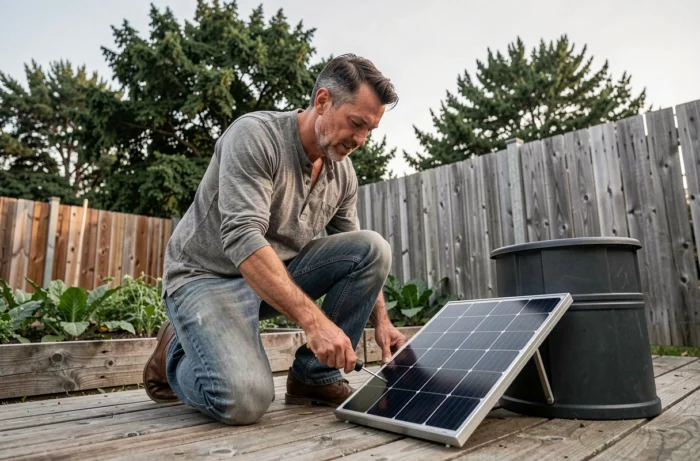
8. Photovoltaic panels coupled with a thermodynamic water heater
Producing solar electricity has limited interest if most is fed back into the grid during off-peak hours. Coupling the panels with a thermodynamic water heater (heat pump water heater) allows for direct self-consumption of daytime production to heat domestic water.
This coupling increases the self-consumption rate without requiring a storage battery. The thermodynamic water heater functions as a thermal energy reservoir, accumulating heat when the sun is producing and releasing it on demand.
9. Local composter to reduce organic waste
Source separation of bio-waste is now part of regulatory obligations in France. An individual or shared composter transforms kitchen and garden waste into soil amendment.
Points to check before installation:
- The location should be shaded and on bare earth to allow colonization by soil microorganisms
- The carbon/nitrogen ratio (dry matter/wet matter) conditions the speed of decomposition and the absence of odors
- Regular turning (every two weeks) maintains the aeration necessary for the aerobic process
10. Coordinated work package rather than isolated actions
The energy performance diagnosis (DPE) is becoming a determining criterion for accessing the comprehensive renovation pathway of MaPrimeRénov’. Aid schemes now encourage work packages that include several insulation measures and a decarbonized heating system.
This global approach is not just administrative. From a technical standpoint, the coordination between insulation, ventilation, and heating determines the actual performance of the renovated building. Insulating without ventilating creates pathologies. Changing heating without insulating oversizes the equipment. The date of submission for aid determines the applicable regime, not the date of the quote or the start of the work.
A prior energy audit remains the best tool to prioritize measures and calibrate each intervention according to the existing structure.